Care is Not the Only Fuel for Realizing Empathy

One of the most important things we learn
in our journey
of realizing empathy

is that our care
can actually get in the way
of realizing empathy.

Care is good,
but as a fuel for realizing empathy,
it often burns too quickly.

And once it burns out,
what’s left
are residues
of bitterness,
frustration,
and resentment.

Appreciation
is an alternative fuel
for realizing empathy.

It is not an intuitive fuel to use.
It is also not as strong.
But it is powerful enough
in most cases.
It is also more sustainable.

There are different fuels
we can choose to use
when working towards
realizing empathy.

Let us choose
appropriately.


p.s: My colleague Julia Dorbic was gracious enough to interview me on a related topic called Bringing Design to Human-Human Interactions​.

When Diversity & Inclusion Programs Don’t Work

Most diversity and inclusion programs are primarily concerned with biases. They attempt to change someone’s behavior by telling them they’re biased. This could be effective if people were merely unaware of their biases.

In all other cases, it’s important to recognize that biases may also be either directly or indirectly fulfilling a basic human need. If letting go of a bias means depriving ourselves of our needs, we’ll experience tension. Now it’s no longer just a matter of awareness. It’s also a matter of fulfilling our needs and relieving our tension. That’s much harder.

If we’re serious about diversity and inclusion, we have to also help people discover or create an alternative way of fulfilling their needs.

Human Literacy

Computer literacy is all the rage these days.

It’s certainly nice to be computer literate. Important, even.

What about human literacy?

How to love.
How to grieve.
How to be be confident.
How to understand yourself.
How to manage your emotions.
How to fulfill each other’s needs.
How to be different with each other.
How to be honest despite fear of vulnerability.

We rarely pay attention to these. It’s as if we’re expected to just know how to do these things without training.

It’s often only after we have lost something precious (i.e. health, money, marriage) that we begin to pay attention to them.

By then it may be too late.

We need to start human literacy much sooner.

Certainty, not Uncertainty, Fuels Our Fear

We often say uncertainty
is scary.

Not exactly.

In situations of uncertainty,
there often co-exists
a feeling of certainty.

Except,
the certainty is of a negative future consequence.

Even if it’s not absolutely certain
something bad will happen.
It feels like it will.

What’s scary about uncertainty
is not uncertainty.

It’s the relationship
between feeling certain of a negative future consequence
and feeling uncertain of a positive future consequence.

Certainty is what fuels our fear.

To navigate uncertainty
we have to find a way
to decrease the certainty
of a negative future consequence.

In doing so,
we can start to let uncertainty excite our curiosity,
thereby turning it
into a motivator.

Pause, Reflect, Relieve Tension

When we live a life
too busy
to pause
to reflect,
we can feel overwhelmed
with things
to do.

We’re constantly seeking
to release our tension.

Yet no matter what we do
we don’t feel our tension
release.

Mired in tension,
we also don’t feel
we have any room in our being
to be fully present
with others,
to be wholly honest
to others,
to be sufficiently receptive
of others.

So we interrupt them,
we present them
with a mask of politeness,
we yell
and criticize them.

All behaviors
that fuel disconnection
despite best intentions
and our—ironically—
deep-seated need
for connection.

One of the simplest,
yet most important
and difficult things we can do
as founders
is to relieve ourselves
of our own tension,
by realizing empathy
with ourselves.

Men, not Unlike Women, are Complex

In a workshop I lead,
a woman—a wife—
publicly shared
that she never realized
how complex
men were.

She’s always assumed
men
were simple.

She witnessed
that when a coach creates a space
in which men
can be brave enough
to expose their feelings
of fear and shame
the complexity gets articulated.

It’s difficult o articulate what we’ve yet to learn how,
especially when there is social risk.

It often feels easier
to hide
or to repress.

Many men live this way
their entire lives.

There’s significant misunderstanding
or misperception
between men & women.

Much well-intended,
but overly simplistic misinformation
as well.
(i.e. Men are from Mars,
Women are from Venus)

These may mask things in the short term,
but things can eventually erupt.

Losing Touch is Natural

A colleague I had lost touch for nearly a decade reached out to me few weeks ago.

We had a wonderful chat.

What struck me was that he felt hesitant to reach out because he hadn’t kept in touch for a long time.

Let me be clear.

If you’ve entered my life at one point in time, no matter how long we’ve lost touch, you’re still in my life.

Please do not hesitate to reach out to me. Losing touch is one of the most natural things that can happen in life. There’s nothing wrong with it.

This is even more so if you wish to ask me for a favor. Please ask me for favors. I’d love to help if I can. I feel alive when I’m contributing to other people’s lives. If I can help, you’re doing me a favor.

The Irony of Care

I thought I was empathizing.

I wasn’t.

It was nearly 20 years ago.

I had a dear friend who was suffering from bipolar depression.

At the time, I had recently graduated from college with a degree in computer science. I prided myself in being an excellent problem solver. So I was determined… to solve my friend’s problem.

So What did I do? Well, I started by reading books, articles, papers, you name it, I read them all.

After gaining enough understanding of the theory of depression, I went to a local support group looking for some practical advice.

What I learned there was that the best way to help my friend was to try and empathize with her.

What this meant was that the next time my friend got depressed, I was to sit down with her and listen to her carefully. Once I could understand how she’s feeling and why, I was to express this understanding back to her. According to the people at the support group, if my understanding was correct, my friend will feel understood and that’ll make her feel better.

I was surprised.

It sounded too easy to be true.

But then I tried.

The whole time I was trying to empathize with her, she kept yelling, screaming, and bawling. Telling me that I did not understand.

What was I supposed to do? I kept changing what I said, over and over and over again, hoping… that I would eventually get through to her.

But I couldn’t.

Nearly half an hour went by and I was just sitting there with all my energy drained, exhausted and unable to figure out what I was missing.

But then… something occurred to me.

I suddenly remembered that, earlier in the day, I had said something to her, which, in hindsight, was hurtful.

So I told her that.

And like magic, she stopped yelling and screaming, as she sat there sobbing… while I finally… empathized with her.

What I realize now is that everything I’d been telling her up to that point was framed in such a way that it was all. her. fault, and I had nothing to do with it.

This was not because I had malicious intent. In fact, I had great intentions. I cared for her well-being. I wanted to help. This is the very definition of compassion!

Yet, in hindsight, I learned that despite best intentions, compassion actually lead me to frame the situation as a problem to be solved. And in doing so, 3 things happened to my mindset. 3 things… that lead me to unintentionally do more harm than good.

Now, what do I mean by this?


Distancing to Divide

First of all, I played the role of a problem solver. In doing so, I subconsciously distanced myself from my friend, to the point where I felt sufficiently divided from her.

Why did I do this? Because I was there to help her. Not the other way around. I was concerned for her wellbeing. Not mine. After all, my friend was the one with the problem, not I.

How can a problem solver possibly be a part of the problem? How can the helper be the one being helped? They can’t. It makes perfect sense for us to be divided.

But of course, in the end, I realized that I was, in fact, a part of the problem. My distancing blinded me to this.


Elevating to Judge

Second of all, in treating my friend as someone with a problem, I subconsciously elevated myself above her, to the point where I considered myself to have the superior authority to judge. Judge not only her problem as bad, but also my understanding of the problem as right.

Why? Well… Because I spent months studying depression. I may not have been the world’s expert, but I was surely a better judge than she was!

But of course, in the end, I realized that I was not a good judge at all. She was feeling the way she was, not because of depression, but because of something hurtful I had said. That’s not something I knew enough to claim authority. In other words, I didn’t know enough to elevate myself above her and judge.

So she was not wrong to reject my understanding. In fact, if anybody was wrong, it was me. I was wrong.


Focusing to Hold on

Finally, I held onto my distance and judgment. Not only that, but I also held on to a solution I had come up with even before entering the conversation.

Guess what solution I had imagined for my friend?

She. just had. to. cheer. up!

What a beautifully simple solution, right?

I held on to this solution, because I also held on to the judgment that my understanding of her was right.

But of course, in the end, I not only realized that my solution was wrong, but that the actual solution was completely new and unexpected. Yet, it was also so very obvious, simple, and even logical in hindsight. So much so that I could not understand why I hadn’t thought of in the first place. So what I had to do was actually let go of my judgment and solution, not hold on to them.


Empathizing and Not Empathizing

In the popular media, there is significant misunderstanding around what it means to empathize. Most confuse it with feeling what other people are feeling (That’s called emotional contagion.). Many people, like I did, also confuse techniques like active listening as being analogous to empathizing. It isn’t.

Empathizing isn’t something we do, it’s something that happens. It is an event and an experience, when we enter a state of feeling as if we’re connected or at one with an “other.” Reflecting on my mindset at the time, I now clearly see that I was entering a state that made it harder for myself to empathize with my friend. I thought I was empathizing, but I clearly wasn’t.

This isn’t to say that there’s nothing we can do. There are plenty of things we can do. Listening actively is one of them. It’s just that merely listening actively is not always enough.


Looking back, something that greatly surprised me was that once I empathized with her she thanked me.

Why was this surprising?

Because it was not what I thought was worthy of her gratitude.

It took me a significant amount of reflection before I became aware of the fact that my compassion was tied to my own need to make a contribution to her life. Reflection also helped me become aware of a belief I had, which was that to contribute to her life I had to problem solve.

Since I was unaware of how my own needs and beliefs were tied to this, I was so surprised that she didn’t appreciate this. In fact, after several trials, I started to feel indignant of how ungrateful she was of my efforts to help her. Why? Because she was not appreciating what I thought she should appreciate.

In hindsight, I am now more surprised that what I called “caring” meant little more than trying to persuade her. I wanted to get her appreciate what I appreciated. I was trying to manipulate her! Seen this way, I realized that the way I was expressing my compassion and contribution got in the way… of actually contributing to her life.

Such… is what I call the “irony of care.”

Now, let me be clear.

I do not wish to criticize the problem solving mindset.

A problem solving mindset is most certainly appropriate when faced with a problem like so:

1 + 1 = ___

Why?

  1. You cannot influence the problem, which means you cannot be a part of the problem. Thus, it makes no difference that you divide yourself from the problem.
  2. There’s no ambiguity around what is right/wrong or good/bad. Thus, assuming to have the authority to judge does not imply superiority.
  3. There is only one solution. Feel free to hold on to it.

Problem solve away if these conditions are met. It is only when these conditions are not met that you need an alternative mindset.

Now that I’m in my 40s, it’s been almost 20 years since the time of the incident with my friend. Yet, I still find this event to be a gift that keeps on giving.

In my work, I frequently work with CEOs who have no choice but to frame employee growth and engagement as a problem to be solved. I also work with employees who have no choice but to frame executive leadership as a problem to be solved. They both inevitably find out that problem solving is ill-suited for the situation. How do they find out? Usually, when the employees don’t grow much or leave and the executives start to burn-out or become even more agitated.

I recently gave a keynote at Cleveland Clinics’s Patient-Experience Summit, where I learned that doctors had framed patient-care as a problem to be solved. The patients, of course, had framed these doctors’ approach to care as a problem to be solved. As a result, not only were patients not getting any better and leaving to other hospitals, but the doctors were burning out as well. They had both learned that problem solving is ill-suited for the situation.

To judge any of these as good/bad or right/wrong misses the point. This is merely what happens naturally when we individually do not have the freedom to choose an alternative mindset to problem solving in the relationship that is giving rise to the problem solving mindset. It is also a natural byproduct of an environment that doesn’t make it any easier for people to empathize with each other.

Learning to choose an alternative mindset or designing an environment that makes it easier for people to empathize with each other is a difficult challenge. Perhaps a way to get us started is to ask ourselves and each other the following question and to answer it in an honest way.

Why do we believe the problem solving mindset is appropriate to our situation?”

• • •


Photo credit to Nicdalic

Dear Mother,

There has been seven instances when you almost died.

Seven.

It started with the Korean war.

The war broke out on June 25th 1950. On January 4th 1951, citizens of Seoul made a retreat to Busan. You took part in that retreat as a recently-born infant.

There was an unspoken rule for taking babies on this retreat. If the baby made too much noise, she was to be abandoned. Why? Because it would give away their position to the North Korean army. Kind of a difficult request for an infant, I think.

Well somehow… somehow… you didn’t make much noise.

You lived.

Having never gone through a war, it’s impossible to imagine what it must have been like. From what you shared, there was little food to go around. Your mother and her 3 children were mostly starving. So much so that she had difficulty breastfeeding you.

You eventually became so skinny that your limbs started to curl out of malnourishment. Given war time difficulties, the hospital couldn’t give much help. Your parents did their best to feed you what was available. Unfortunately, you didn’t show any sign of improvement.

The mere sight of you must have been too much for your parents to bear. They also had two other children to feed with a fourth one on the way. As difficult as it must have been for them, they eventually made the decision to give up on you. So one night, you were left outside in the cold with the expectation that you would die before sunrise.

Well…

You didn’t.

You didn’t die.

You. Just. Wouldn’t. Die.

Your parents were surprised. They took you back. They kept feeding you. You didn’t get much better, though. You grew up as a very skinny child.

You lived.

When you were a 5th grade student. A motor cycle hit you. You flung in the air before falling to the ground.

You lived.

When you were in college, you ran into a fortune teller. The fortune teller took one look at you and said, “Tsk… Tsk… You will die at the age of 38.” As much as you were mortified by such random and cruel expression of premonition, these few words would eventually return to haunt you.

It started with an acute pain you felt in your lower abdomen. You were 38. Our family was living in Cairo, Egypt.

When you got to the hospital, you were diagnosed with a chronic case of appendicitis. The kind where slow and acute symptoms of pain occur over time instead of rushing in all at once.

You were told you needed an operation right away. As much as you understood the urgency, you refused. As a foreigner, you felt more comfortable waiting until you were back in Korea before receiving an operation.

Now…

Imagine you were your son. (That would be me.) How would you be feeling at this point? Worried, perhaps. Imagine yourself accompanying you on a flight to Korea. What would you be doing with you? Cuddling up next to you to comfort you throughout the flight, perhaps.

Not me.

Apparently, I was mesmerized by the view outside the airplane window. As we got close to our layover in Singapore, I must’ve noticed that there were fireworks happening on an island nearby. I’ve been told that I asked you if we could go see it. You said “yes.”

We went out, hopped on a cab, went over to the cable car dock, took the cable car, crossed over to the island, watched the fireworks, took the cable car back, hopped on a cab, and returned to the airport.

Things a son will make their chronic-appendicitis-patient-mother go through to watch some goddamn fireworks.

We eventually arrived at a hospital in Seoul. The doctor opened you up. He said you were lucky. Your appendix had already ruptured in various places. He said you could have died had you waited one more day. Well, you didn’t.

You lived.

But, it wasn’t over.

Later that year, you developed a severe case of hemorrhage. By then, our whole family had returned to Seoul for good. You were still 38.

The hemorrhage was so severe that you were bleeding out into a bucket. Turns out, it was a delayed effect of too much use of force during my child birth.

You lived.

At the age of 52, you went through craniotomy for aneurysm. You had to write a will. The risk of death was too high.

You lived.

At the age of 56, you had uterine cancer, and went through hysterectomy.

You lived.

There are many things you have helped me learn to appreciate.

One of them is the grace of luck.

You often talk about the critical role of technology in your life. For example, many of your illnesses could not have been helped a generation prior. The technology just wasn’t there. There is much to be grateful for when you recognize this coincidence.

The other is the value of “living as we are born.” (My rough translation of a Korean phrase: 생긴대로 살자).

“Living as we are born” isn’t to eschew change or development. After all, we are born with a natural ability to change and develop. In fact, the phrase is not meant to be taken literally at face value. You use the phrase to merely point to what you have learned from living through multiple near-death experiences.

As an outside observer, it’s easy to feel inspired by someone who has lived through several near-death experiences. At the same time, what I know is that the person who has gone through them live with physical and emotional scars that never disappear. The moment we notice these scars, we are instantly reminded of our past wounds without prior warning.

This is not easy. Not easy at a all.

What you have learned from these experiences is that life is fragile and precious. So you do not wish to waste time shaming yourself in comparison to others who were born to a different set of circumstances. You also do not wish to waste time living up to somebody else’s expectations on how your life should be.

You say you’re lucky to have repeatedly faced your own mortality. You say you may have otherwise learned these lessons too late. Although, you are quick to add that learning these lessons was only the beginning. The beginning of a life-long practice.

Thank you, mother, for living the way you were born.
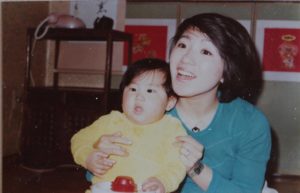

Photo credit to an unknown photographer